
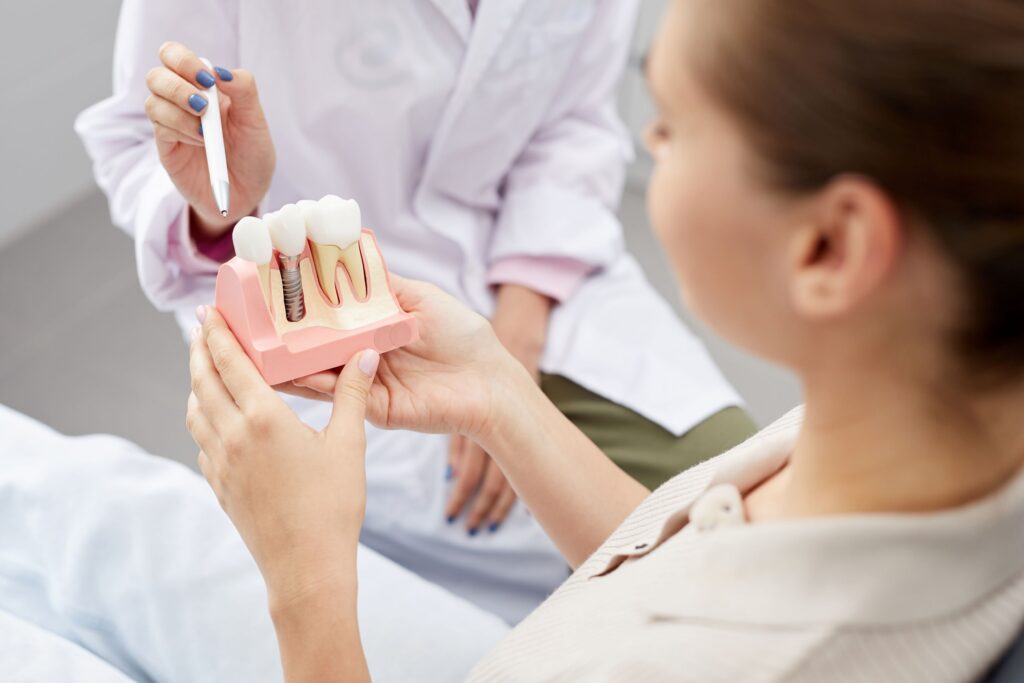
Although dentures and dental bridges are both effective ways to rebuild smiles after tooth loss, many experts consider dental implants the ideal treatment because of their unique benefits. They’re the only option that is embedded directly in your jaw and fuse with the bone to become a more permanent part of your mouth.
This typically makes dental implants stronger and longer-lasting than the alternatives, but that doesn’t mean they’re invincible. You must care for them correctly to avoid potential failure, and that includes flossing. Continue reading to learn about proper flossing techniques to help maintain your restoration!
How Do Dental Implants Work?
Getting dental implants typically takes multiple appointments spanning a period of months because they involve oral surgery. Once the biocompatible posts are positioned in your jawbone, it can take 3 to 6 months to recover, because that’s often how long it takes the mouth to generate enough new bone to fully encompass and fuse with the material.
Once you’ve recovered sufficiently, you’ll undergo a second, more minor procedure to place the abutments, or connector pieces, on your implants, which will eventually anchor your restoration. When the time is right, your dental team will make impressions of your teeth and gums and use them to design a customized dental crown, bridge, or dentures to attach to your implant(s), depending on how many teeth went missing.
Why Is Flossing Important with Dental Implants?
Would you be surprised to learn that a pervasive form of gum disease, called peri-implantitis, is the leading cause of dental implant failure? This infection is triggered when unhealthy bacteria in your mouth penetrate the surgical site and thrive, which can eventually erode the connective and bone tissues holding your new tooth in place. As a result, it’s more likely to become destabilized or dislodged.
Thankfully, this condition can also be prevented with routine maintenance. For instance, brushing and flossing twice daily removes unwanted germs and plaque to help avoid common oral issues that might harm your prosthetics.
What is the Best Way to Floss with Dental Implants?
It’s important to floss carefully around your new tooth because, unlike the ones you were born with, it’s not held in place by muscles, ligaments, and other connective tissues. Instead, it has a protective seal that forms around the post inserted in your jaw, which is less secure. If you press your floss too deeply into the pocket around your restoration, you could damage the seal, allowing bacteria to enter the site.
That means you must be gentle when flossing around your implant. Wrap the string around your fingers then slide it carefully beneath your gums in a C-shape. Then, use sawing, back-and-forth motions rather than push the thread up and down, which can be abrasive. Some patients prefer to use thicker, spongier floss or an oral irrigator, which relies on a pressurized stream of water to clear debris from their teeth and gums more gently.
If you have additional questions about how to care for your restorations, you can learn more by contacting your dentist’s office directly.
About the Practice
Patients at Sweet Family Dentistry benefit from a husband-and-wife team who are passionate about helping people build and maintain beautiful, healthy smiles. Dr. Chan and Dr. Yip collaborate to provide a complete menu of services, including placing and restoring dental implants, to meet your family’s unique needs conveniently under one roof. Their caring approach is paired with advanced technology to deliver comfortable, accurate results meant to last. You can request an appointment on the website or call (972) 905-0340.